 read
read 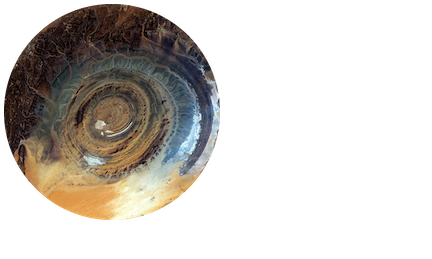 read The Atlas Hypothesis — a technical briefing
The titan who holds the skies.
That guy who has the ocean and the mountains named after him.
Also a megastructure.
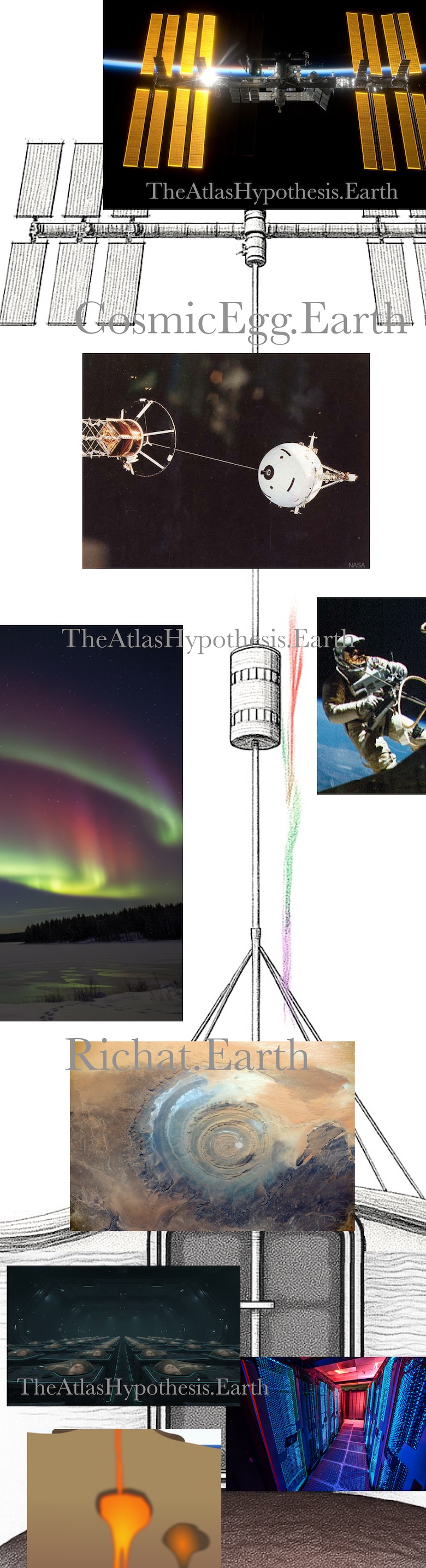
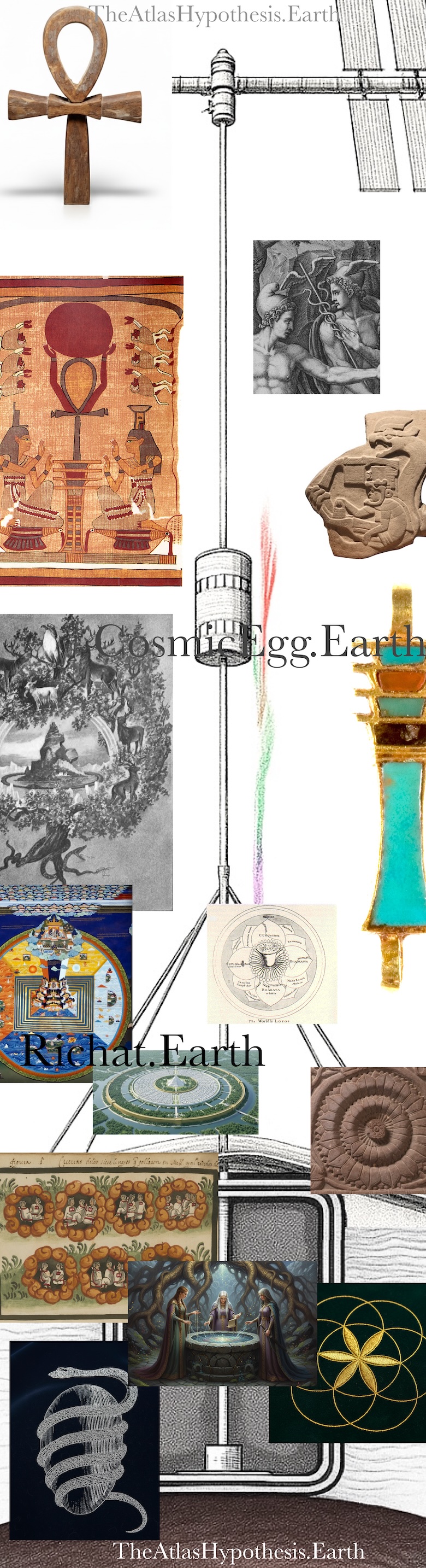
Atlas shows up in every mythology — you just never noticed, because myths are too busy with over-the-top divine love affairs to talk about the really exciting questions — like how to keep a planet-scale civil-engineering system, long out of warranty, structurally intact under extreme stresses. Yet if you de-blur your vision of history, and scrape the mythological makeup off the competing accounts of ancient gang-on-gang violence, then what remains is simply — Atlas.
The Primordial Mound of Creation from the Egyptian texts? It's Atlas.
Yggdrasil from the Eddas? It's Atlas.
Chicomoztoc of the Aztecs? It's Atlas.
Hyperborea? Yep. It's Atlas. I'm not kidding.
The Rainbow Serpent?.. You get the idea.
Also the Masonic symbolism. And those two lines on the U.S. dollar sign.
of humanity since Ragnarök — fifteen thousand years ago — been delivered
with such deep respect and piety — and yet, with absurd levity.
Of course, you wouldn’t have much to compare — in the sports of BEFORE,
your civilization hasn’t lasted nearly that long.
Pick an ancient myth or tradition at random; point without looking — you'll probably hit Atlas. Look at the symbols of your country or the earrings of your girlfriend — it’s probably Atlas.
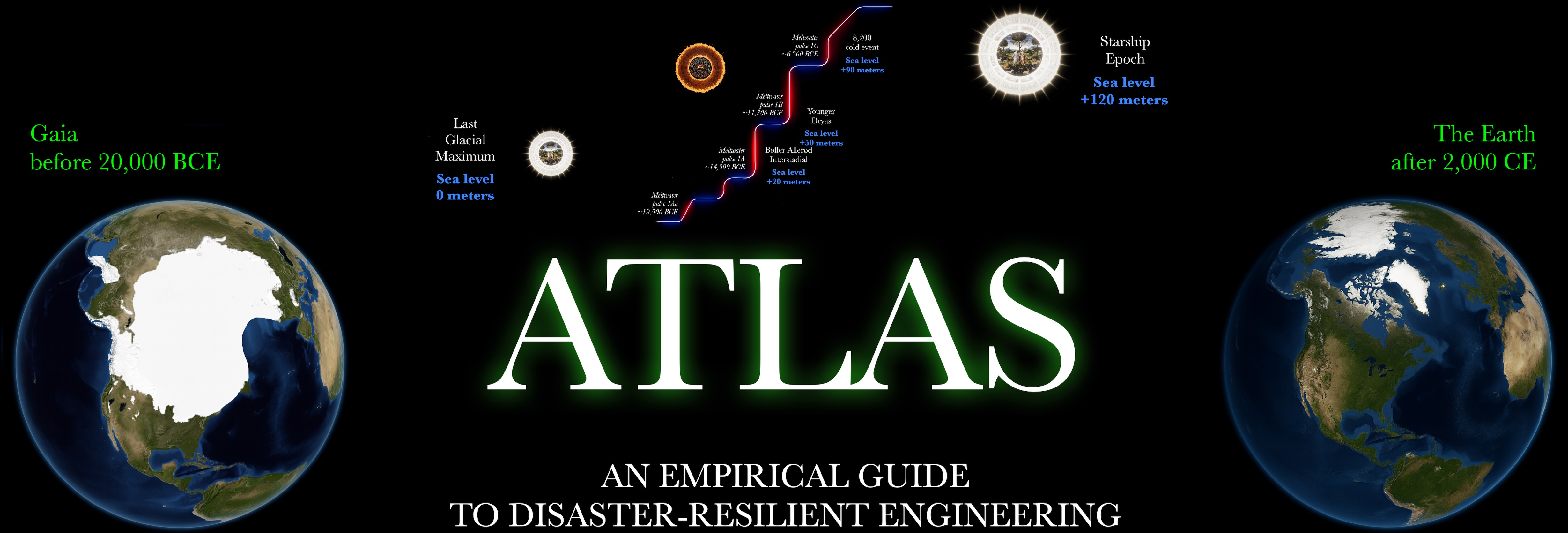
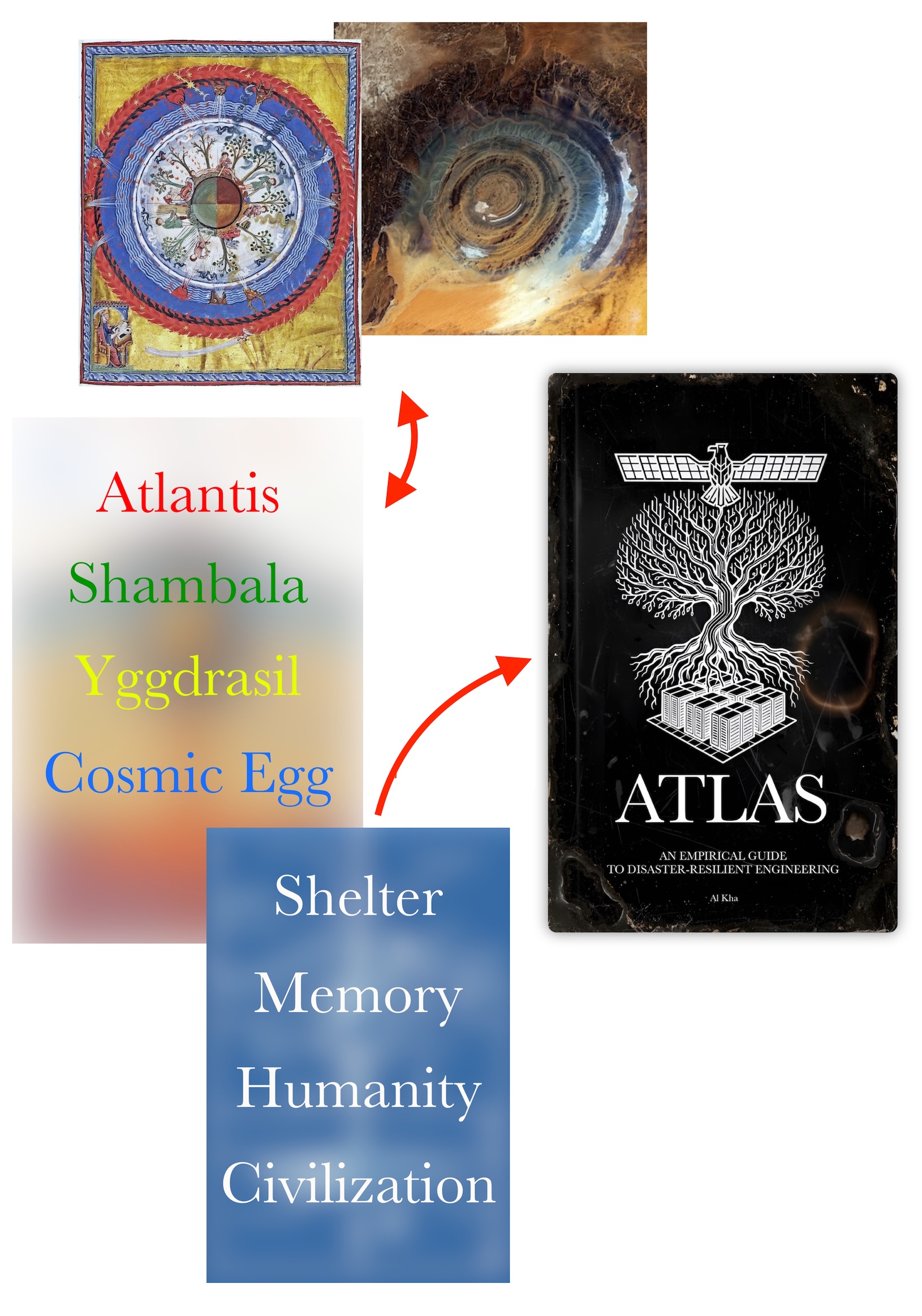
This book, ATLAS: AN EMPIRICAL GUIDE TO DISASTER-RESILIENT ENGINEERING, is a decryption key.
This key unlocks those parts of human history — the parts whispered about, the books denied to exist. You know, the rest of human history — the much more interesting and larger part.
What has been discounted as myth — those pages, dismissed as mere imagination — is accounted for here, in this book. The evidence. The blueprints.
A much more complete timeline of humanity's history — the chapters you were never allowed to see — told in plain English, with full-color illustrations.
It's in the book! But in a way you've never seen it before. With this key in hand, Atlantis is no longer a mythical global hegemonic empire, but a very boringly tangible confederacy of kingdoms. It did cross the ocean, standing on two continents, yet if we could look back in time, it would be notable primarily for something Plato barely mentioned en passe — being the last breath of a much bigger story.
Yes, while itself impossibly ancient, to the point of becoming mythical for us, Atlantis had its own ancient history. And it was a very highly technologically developed ancient history, of which Atlantis was but a trailing edge, at the very end of a long decline.
The famous symmetrical shape? The Atlanteans placed their dwellings in the carcass of an even more perfect design — wrought into this world by their forefathers, colossal in proportion. From the engineering scale of the lost age our today's AGI aspirations would seem like a been there, done that triviality. You have known this long lost age of genius and prosperity as
With this book as a key, even the apocalypse becomes observable and measurable — because it has already happened.
Several times.
On schedule.
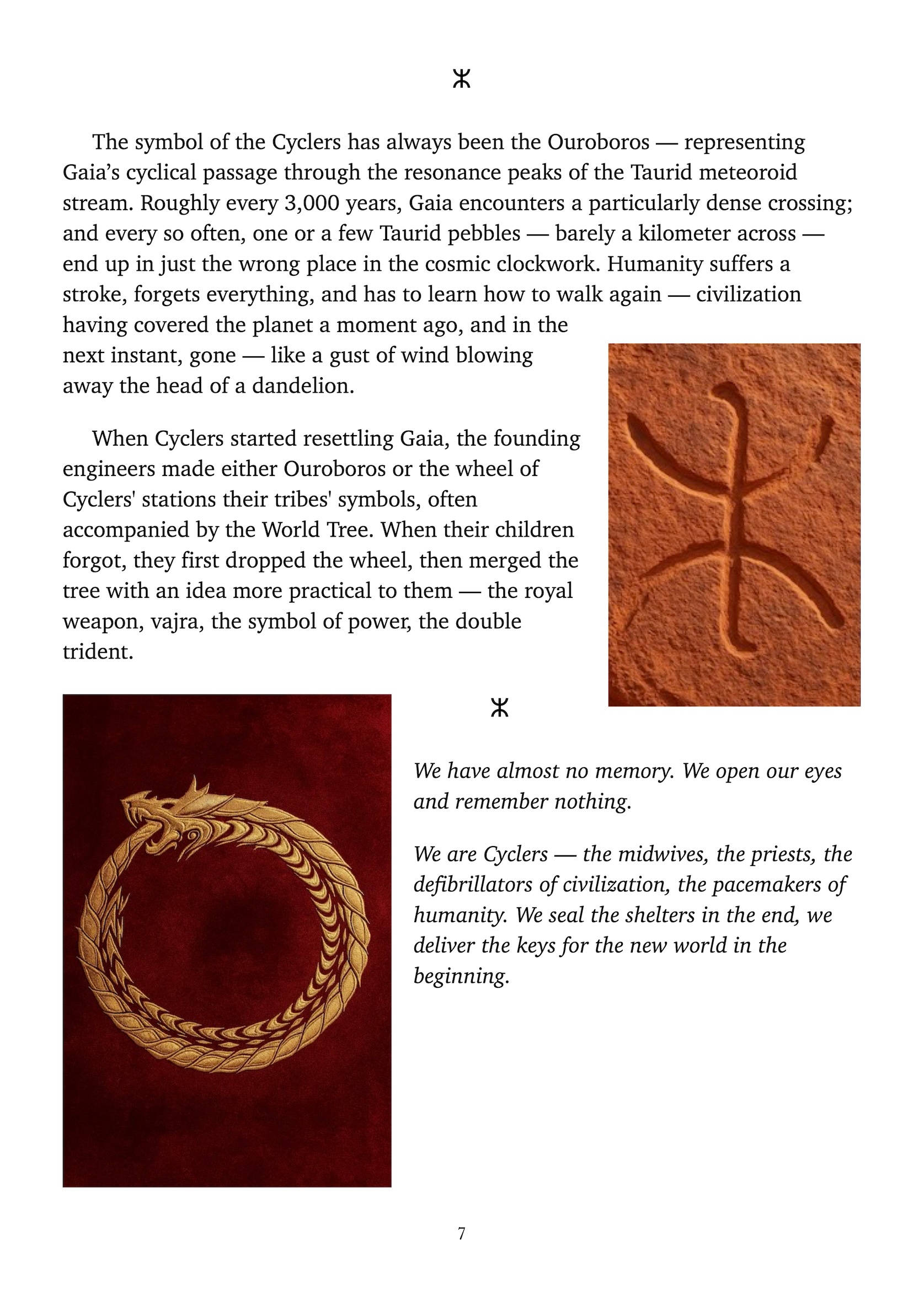
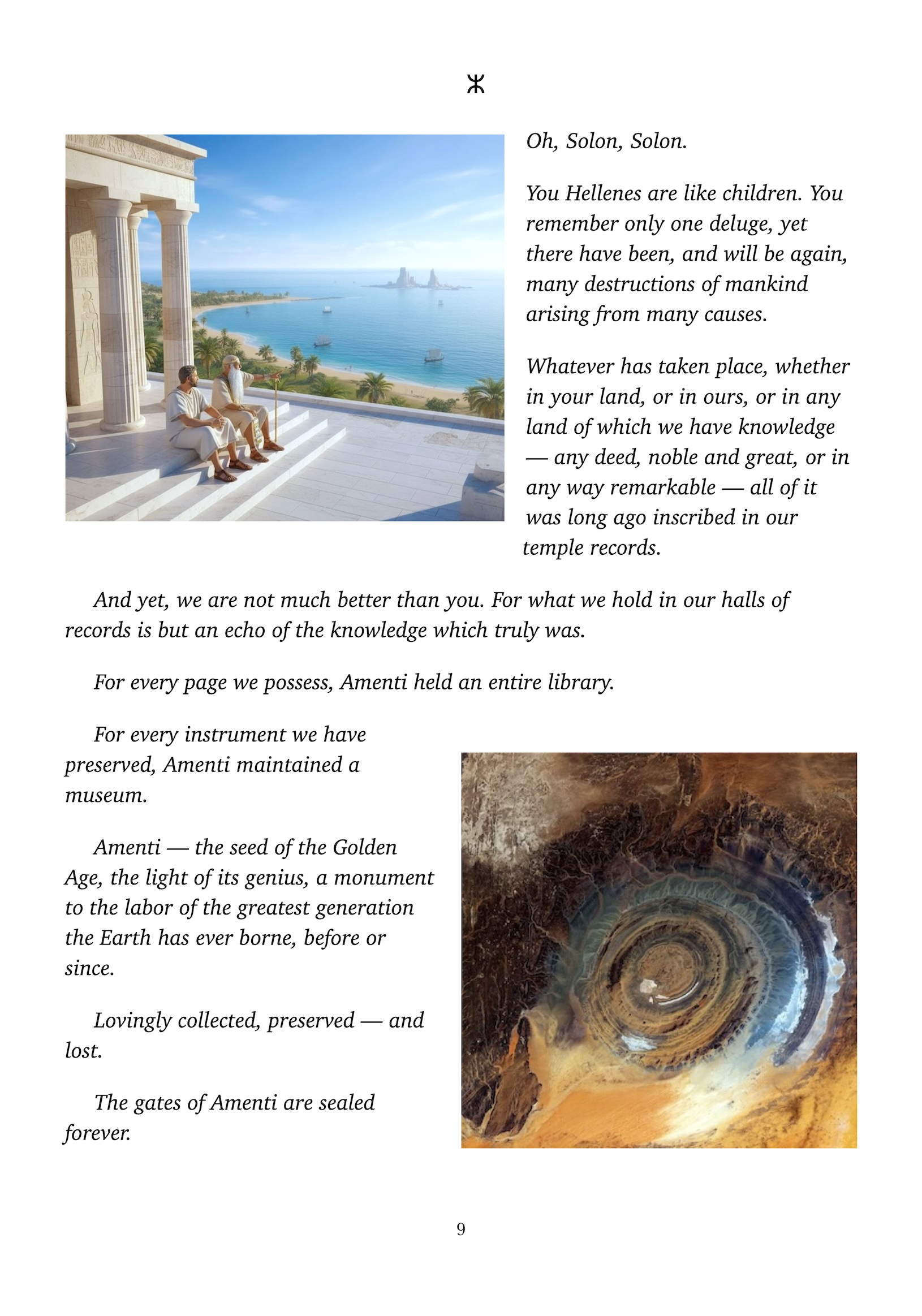
 listen to Abaris, a Cycler (from the Lunar Archives)
This book strips away the baroque storytelling, the tribal politics, and the post-apocalyptic poetry, revealing the structural framework beneath — literally.
And along with the boring part — the history of humanity — this book gives you an X-ray vision through the cultural layers with which we adorn our everyday lives:
Festivals.
Traditions.
Symbols.
But how is it possible for one entity to achive it all? How can an object designed by humans, no matter how large or powerful, have such a decisive effect on our history? I've already hinted you a couple times. You see, it is no coincidence that the protagonist of this story appears in every myth on Earth. It's simple, really.
Nothing else survived the repeated apocalypse.
Only Atlas.
Only Atlas weathered several ends of the world in a row.
Only Atlas, each time, stubbornly stood strong, stretched to the limit, battered by wave after wave of destruction, yet refusing to let go of the skies, in obstinate defiance of the rage of the universe.
And it could not possibly let go. Because at the roots of Atlas, it guarded, protected and nourished the biggest treasure imaginable — the seed of civilization, the seed of humanity itself.
The secret behind the endurance of Atlas is that it was designed for it. Atlas existed for that purpose: to endure through the cycles of destruction.
And it did.
This is why only Atlas, an entity seemingly more resilient than time itself, now remains in the collective memory of humanity under different names — carried across tens of thousands of years.
Nothing else lasted; there was nothing else left to remember. Each catastrophe did not just turn another page of history over, it tore to pieces everything that had been written, leaving humanity in front of pristinely clean sheets, sticking out of a mutilated book.
The resilient Atlas remained the only constant.
While it existed, the indestructible Atlas was the embodiment of our history. Atlas preserved and carried forward our memory, keeping the struggling and uncertain flame of civilization alive in the middle of the hurricane, denying nature her right to get our consciousness erased.
Until even Atlas was no more.
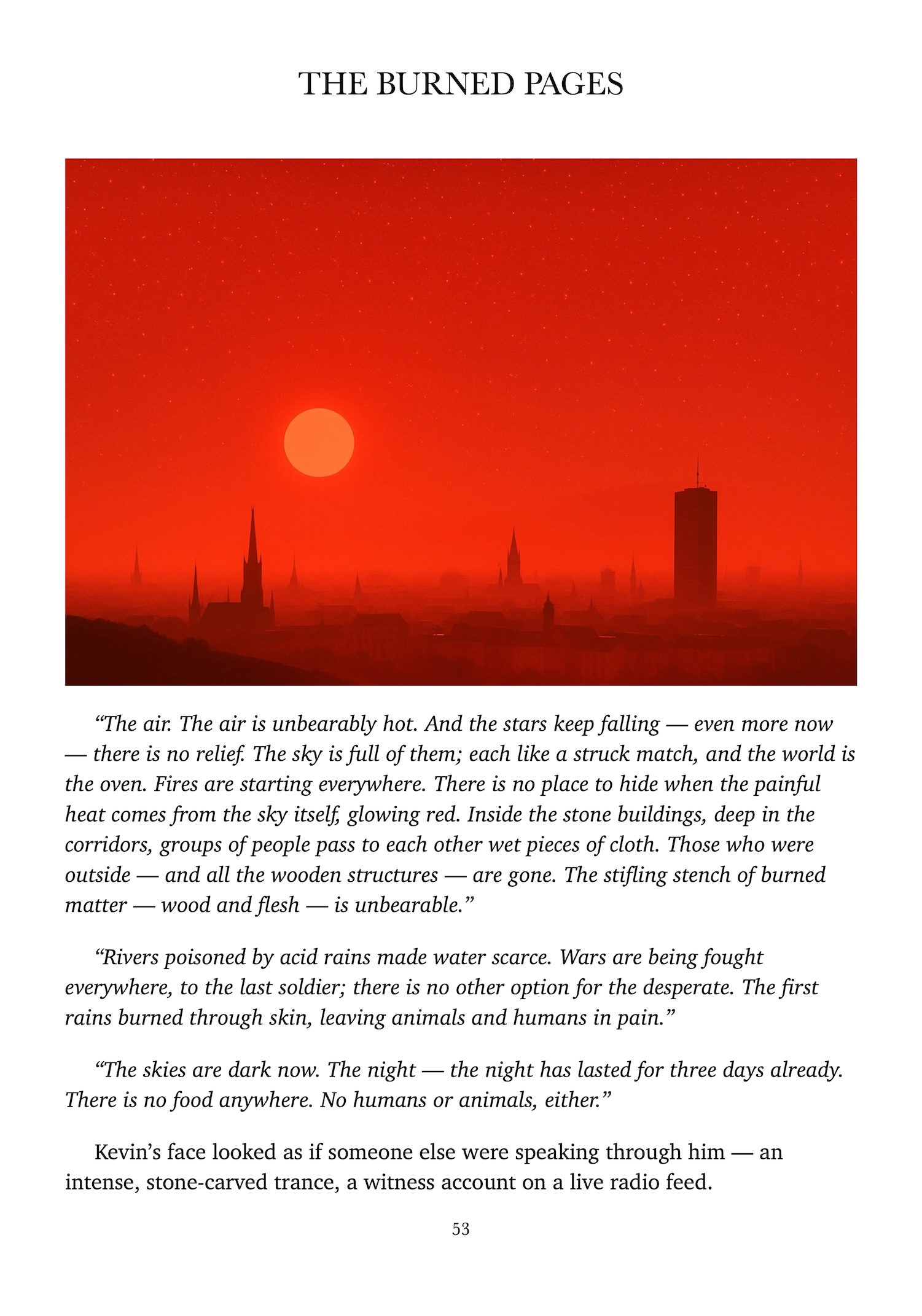
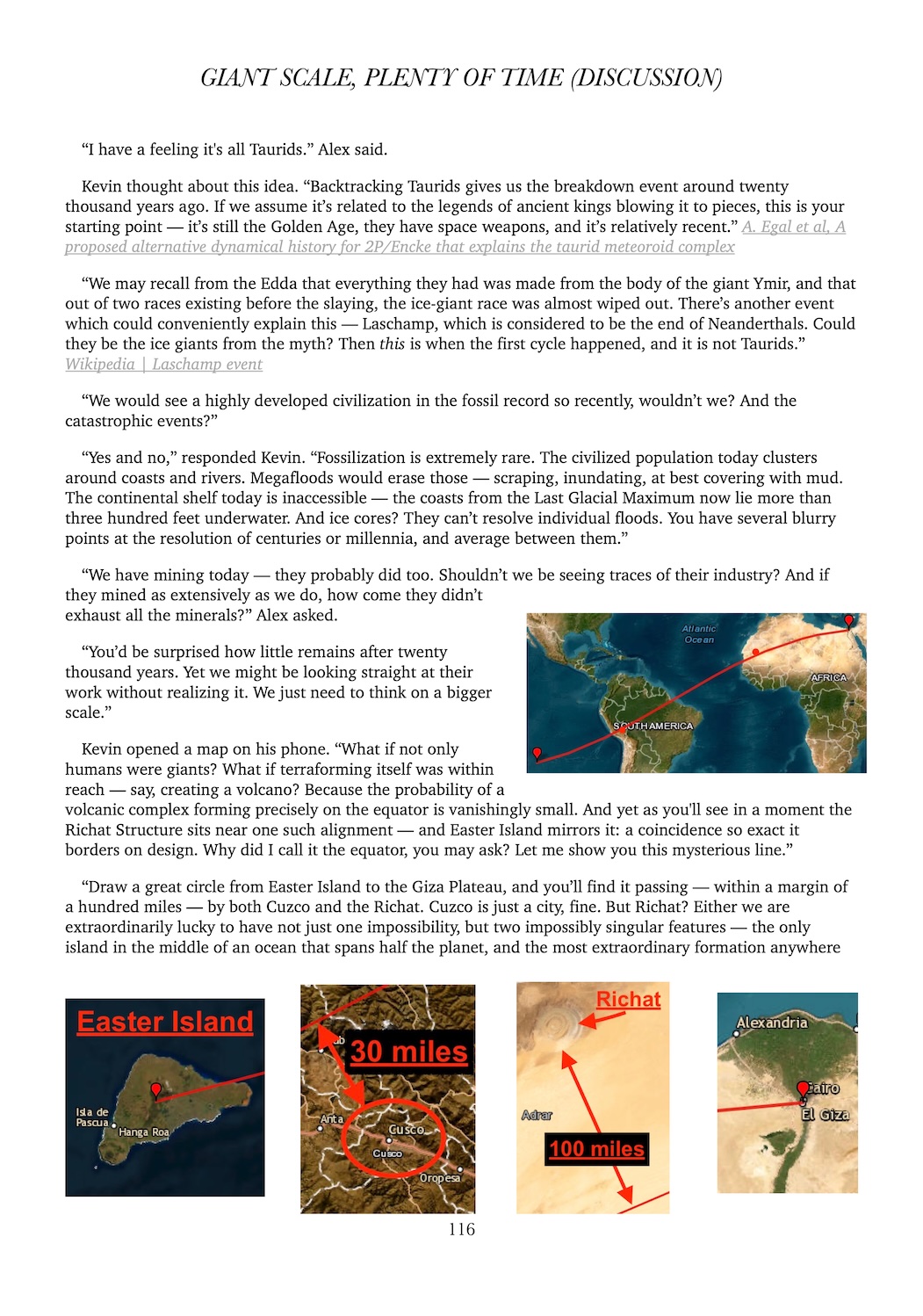
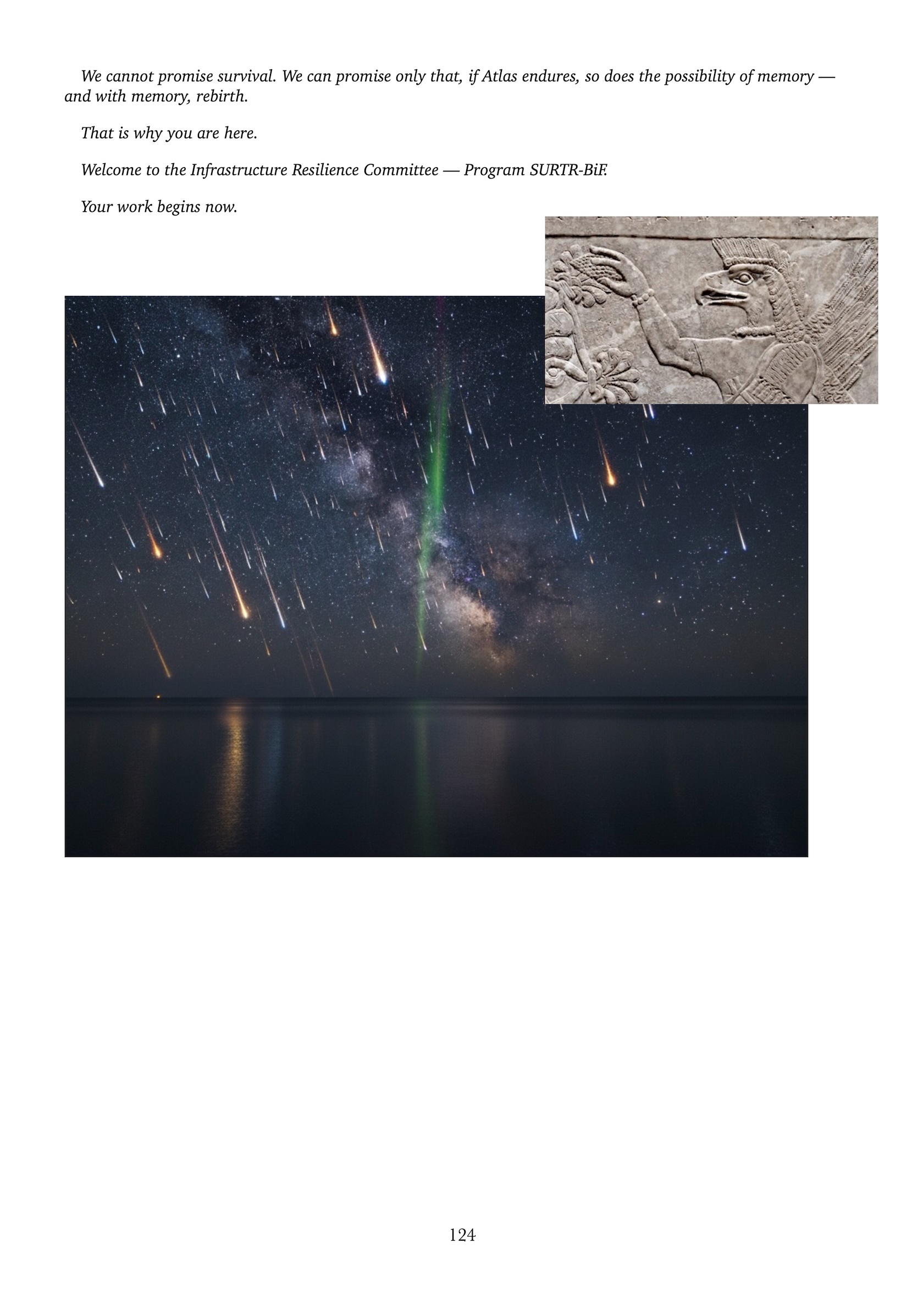
This book is a lighthearted mythical photo album, filled with holiday pictures of what if? and could be. At the same time it is a deeply respectful look through the unimaginably large spans of human history at the Golden Age engineers' design, whose noble goal was to keep civilization alive under repeated catastrophic stresses. And an empirical account, with margin notes, on how it's worked out for us so far.
Those cyclic events carried away not just countries — but millions of living, aspiring, imaginative human beings. They carried away ourselves.
And the so-called magic from the myths? It was our own technology, from before the cycles began — knowledge the planet itself forgot, and only Atlas remembered, while it could.
The Golden Age, the moral and intellectual pinnacle of humanity? It was beaten into the ground, burned, drowned, lost.
The Aztecs told the story of the Five Suns.
The world burned, and the mountains melted.
The world drowned, and capital cities were washed away, scraped off the bedrock with the very soil on which they stood.
Those cataclysms — happening on our planet like celestial clockwork, time after time — now form the foundation of the mythology of any tribe, anywhere on Earth.
Everywhere on Earth.
Because these were never regional natural disasters.
On the whole planet, civilization was repeatedly destroyed and continents erased — each time resetting the few scattered remnants of humanity to the state of cavemen.
And today, as we celebrate the achievements of our own turn at civilization, it’s time to remember that the exam is coming.
We’re probably not the last.
It’s our turn.
— Al Kha ⵣ the author of The Atlas Hypothesis
P.S. If you suffer from anxiety and found this material overwhelming — relax. It’s just an elaborate piece of fictional worldbuilding, nothing more. Take a deep breath and close this page.
 read a silly fairy tale
 take a look at a possible timeline of humanity according to The Atlas Hypothesis
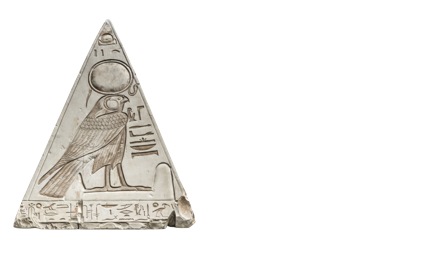 read about The Navel of Atlantis
 see a modern company trying to build an Olympus today